What exercise is safe in a Twin Pregnancy
Twin pregnancy and Exercise: Is it Safe to Stay Active?
If you’re pregnant with twins, chances are you may be feeling a little confused - and possibly overwhelmed - about whether exercise during your pregnancy is safe.
At the Empowered Motherhood Program, we’ve been receiving more questions from twin mums about exercise in pregnancy. And it makes sense. Over the last few years, there has been so much more research coming out around the safety and benefits of exercise in pregnancy, encouraging women to stay active, lift weights, strength train and continue moving in a way that supports their body.
But most of these guidelines are based on lower-risk, singleton pregnancies. There are still very few research studies looking at twin pregnancies alone.
So when it comes to guiding women pregnant with twins, it’s common for people to become cautious or fearful.
But there comes a point where we need to ask: is avoiding movement actually more harmful than helpful?
Twin pregnancy is higher risk-but that does not mean you cannot exercise
One of the biggest risk factors in a twin pregnancy is preterm labour.
We know that around 50–60% of women pregnant with twins will go into preterm labour, which means before 37 weeks. Around 10% of twin mothers will go into labour before 32 weeks.
The biggest fear many people have is that exercise will cause preterm labour. But the research we do have does not show that exercise causes preterm labour in twin pregnancies.
There was a study published in 2021 looking at 650 women pregnant with twins. In that study, 75% of women did not exercise at all, and 25% did exercise during pregnancy.
Of the women who did not exercise:
-
50% reported they were told not to exercise
-
44% reported feeling too fatigued
-
19–30% reported that social feedback or negative opinions influenced their decision
-
Only around 30% felt their family and friends were positive about them exercising during pregnancy
But when we look at the group who did exercise, they had no increase in adverse outcomes and no increase in premature labour or birth.
They were also more likely to have a vaginal birth and more likely to go into spontaneous labour.
So often we are scared of allowing twin mums to exercise because we are fearful of these outcomes; but the outcomes in this study were actually more positive, with no impact on premature labour.
Rest is not always protective
Another important point is that rest itself is not necessarily protective.
When women are put on bed rest during pregnancy, research has shown higher rates of blood clots and DVTs, more muscle weakness and bone loss, lower birth weight, and higher anxiety and depression scores.
So we really need to look at this carefully.
Avoiding movement is not always the answer.
That does not mean every twin mama should be doing the same exercise. It means we need to look at the individual woman, her pregnancy, her symptoms, her babies, and her risk factors — and then make safe, sensible modifications.
Why exercise can be so helpful in twin pregnancy
Women who are pregnant with twins are more likely to experience complications and symptoms such as:
-
Gestational diabetes
-
Increased weight gain during pregnancy
-
Lower back pain
-
More fatigue
-
Urinary incontinence
-
Pelvic girdle pain
-
Pelvic heaviness or pressure
And many of these things can actually be helped by appropriate exercise.
This is why the goal is not to wrap you in cotton wool. The goal is to keep moving as safely as possible.
What makes twin pregnancy different for exercise?
When we think about exercise in a twin pregnancy, there are a few extra considerations.
A woman who is pregnant with twins has a much higher cardiovascular load. She has a higher blood volume pumping around her body, and she may be supplying two placentas, or one placenta providing blood supply to two babies.
She also has a higher mechanical load through her body. Often, a twin belly sits a little further out or wider, and this can happen earlier in pregnancy because the body needs more space.
This changes the gravitational forces through the body. It changes the biomechanics of the body. The pelvis and lower limbs take more load.
This is why you may experience:
-
Back pain earlier
-
Fatigue earlier
-
Pelvic girdle pain
-
Vulval or vaginal heaviness
-
A feeling of more abdominal load
-
A reduced sense of connection through the core and pelvis
These symptoms can make women fearful that exercise will make things worse. But instead of stopping movement, we want to take these things into account and modify appropriately.
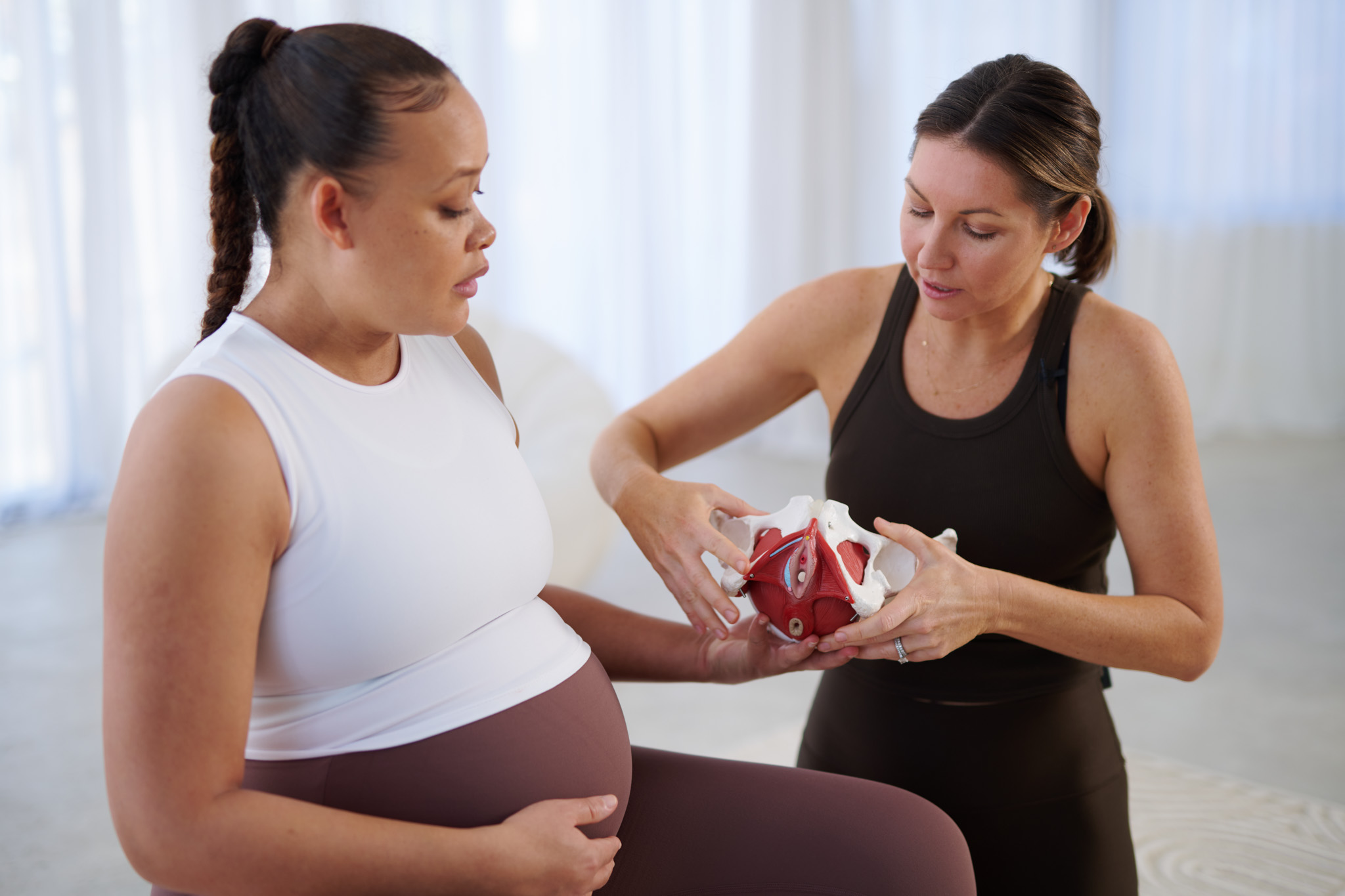
Understanding your risk category
There is no perfect, clear guideline for every twin pregnancy, so we need to use common sense, good clinical judgement and look at the risk factors for each woman as a whole.
A helpful way to think about twin pregnancy and exercise is in three broad categories.
Lower-risk twin pregnancies
These are the women we really want to encourage to exercise safely, at a level that feels right for them, for as long as they possibly can.
This may include women who have twins in two separate sacs with two separate placentas, and who do not have complications such as:
-
Cervical shortening
-
Growth restriction
-
Hypertension
-
Gestational diabetes
-
Other significant obstetric concerns
If you are obstetrically stable, exercise can often be continued with appropriate modifications.
Moderate-risk twin pregnancies
Moderate risk does not mean you cannot exercise.
It means you may need closer supervision and more monitoring of yourself and your babies.
This may include monochorionic twins, where there is one placenta for two babies. In this situation, your team may want to keep a closer eye on blood flow, growth and any emerging symptoms.
It may also include women with milder symptoms such as pelvic pressure, increasing fatigue, or cervical length changes that need to be watched.
In this group, we still want to keep you moving because of all the benefits of exercise, but with closer guidance and more individualised modifications.
Higher-risk twin pregnancies
Higher-risk twin pregnancies may include situations where there is:
-
A very short cervix
-
Higher risk of preterm labour
-
Fetal growth restriction
-
Significant hypertensive disorders
-
Bleeding
-
Babies who are not thriving
-
A need for very close obstetric monitoring
This still does not automatically mean there is no movement at all. But it does mean your exercise needs to be guided very closely by your obstetric team and healthcare providers.
How much exercise should do in a twin pregnancy?
The goal is to stay active most days of the week, but not to push for long sessions.
If you are pregnant with twins, we generally do not aim for 60-minute exercise sessions. You will probably find that 20–30 minutes is more than enough.
The general guidelines for singleton pregnancies are usually 150–300 minutes of moderate to vigorous exercise per week. But in a twin pregnancy, we often want to scale that back.
A helpful guide is to aim for less than 150 minutes per week, spread across the week, with shorter sessions.
Rather than aiming for moderate to vigorous intensity, we want to keep exercise at a moderate level when you are feeling well, and then as pregnancy progresses, shift that back to a milder level.
So we are still staying active and getting the benefits for your muscles and cardiovascular system - but dialling things back.
How hard should exercise feel?
A really helpful way to monitor intensity is using RPE, which stands for rate of perceived exertion.
On a scale of 0 to 10, we want you to keep exercise at around 6 out of 10 or less.
You should also be able to talk through your exercise.
These are simple ways to help you feel confident that you are working at a safe and appropriate level.
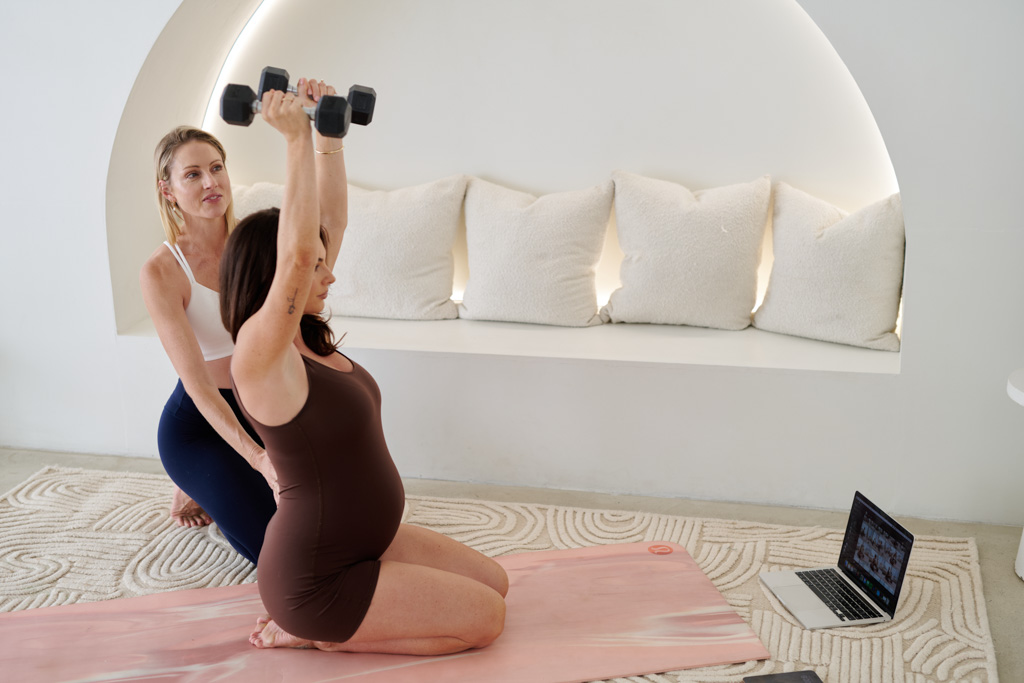
What type of exercise is best in twin pregnancy?
This depends on what you were doing before pregnancy.
As a general rule, what you were doing before pregnancy can often be continued - but with modifications.
In most cases, we want to include:
-
Strength training
-
Cardiovascular exercise
-
Pelvic floor exercises
-
Core exercises
-
Mobility and stretching where helpful
The Empowered Motherhood Program has been created specifically for pregnancy to help you to keep moving safely and meeting your recommended levels of exercise in pregnancy.
Support garments and practical modifications
Some twin mums find that their tummy muscles feel more distended, or that they want more abdominal support as their pregnancy progresses.
Abdominal support garments, pregnancy support tights or specific support devices can help some women feel more supported and connected through their tummy and pelvis.
The aim is not to rely on support forever, but to give your body a little more confidence and comfort while you move.
You may also find it helpful to:
-
Shorten your workouts
-
Slow the tempo
-
Reduce deeper squats or wide positions if they aggravate pelvic pain
-
Choose positions that feel more supported
-
Take longer rests
-
Modify earlier than you would in a singleton pregnancy
Watch your fatigue, temperature and hydration
In a twin pregnancy, it’s important to keep an eye on your fatigue levels, core temperature and hydration.
You may heat up more quickly than someone with a singleton pregnancy.
Exercising in a crowded space without good airflow, air conditioning or fans may not be ideal.
Try to exercise in an environment where:
-
You feel safe
-
You can breathe well
-
You can keep your intensity at 6 out of 10 or less
-
You stay cool
-
You stay hydrated
-
You can stop or modify whenever you need to
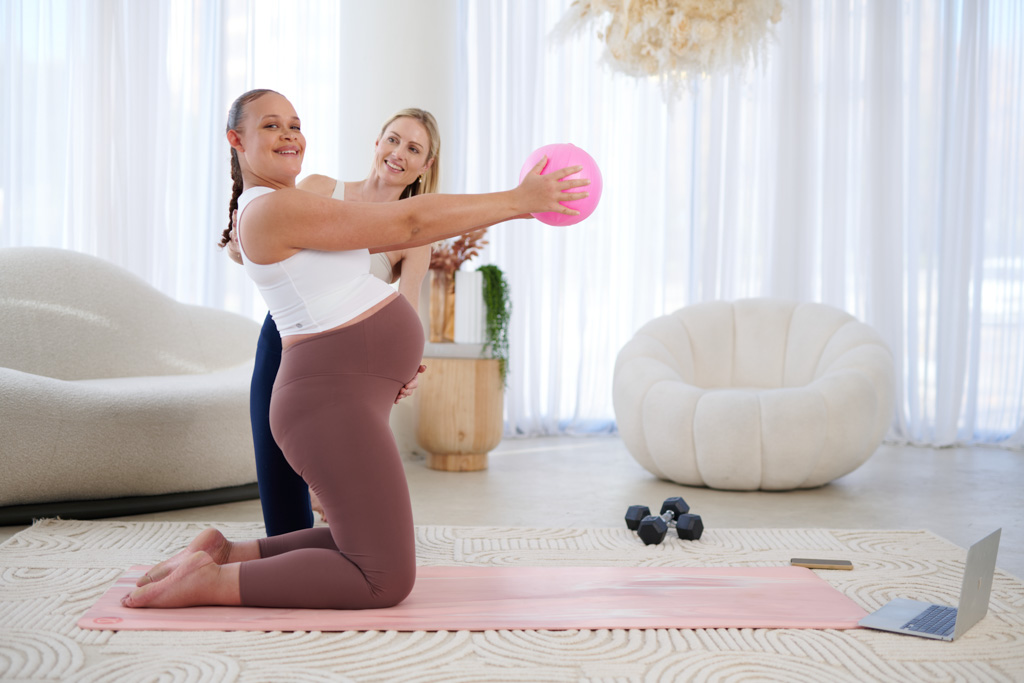
How you can use the Empowered Motherhood Program
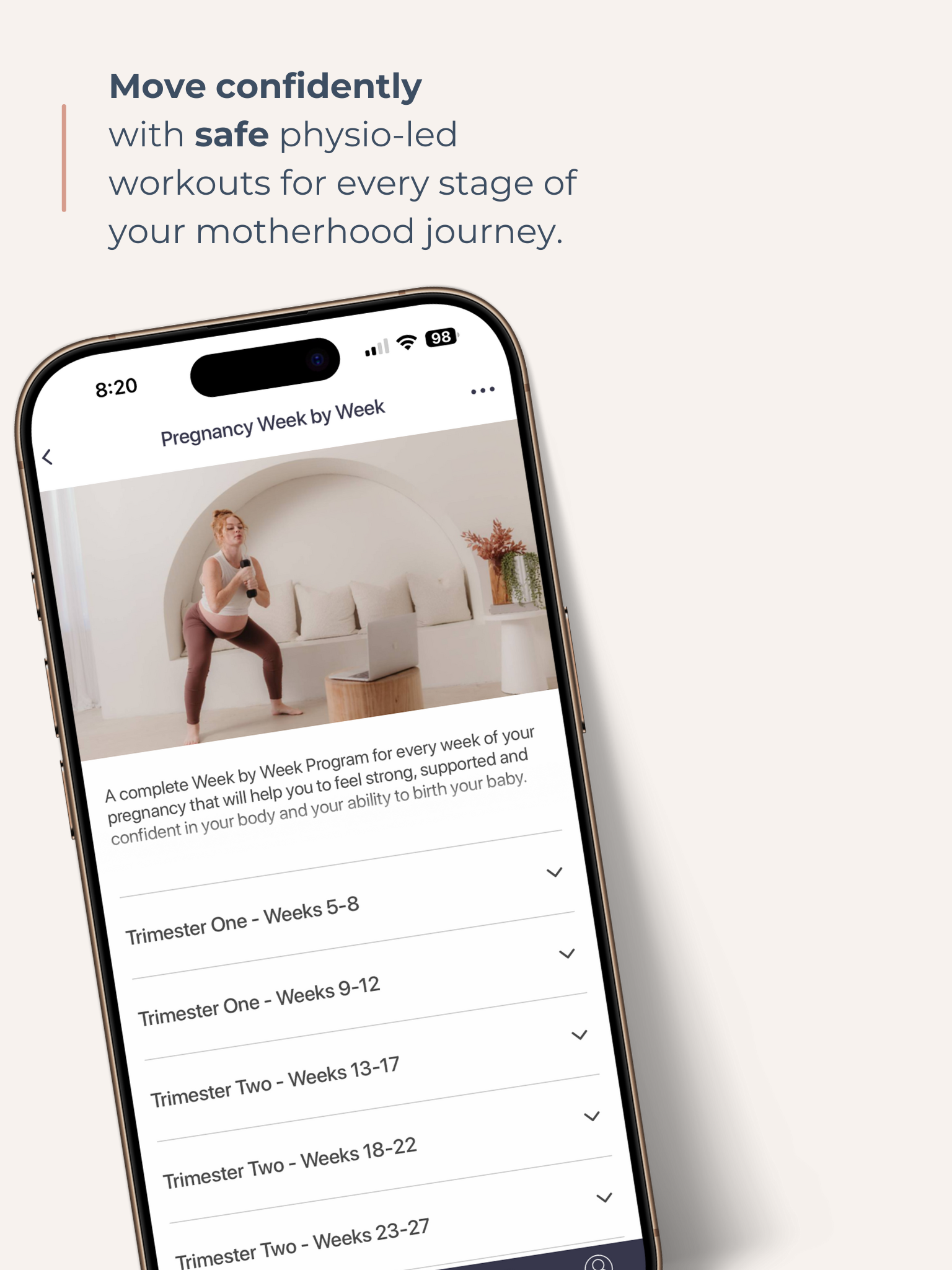
Within the Empowered Motherhood Program, we do not currently have a twin-specific program. But we have guided many women through pregnancy using the pregnancy workouts with modifications.
A common approach is to follow along with the first trimester program and into the first half of the second trimester.
From around halfway through the second trimester, you may start to feel heavier, more fatigued, or like the usual second trimester workouts are simply too much. This may happen even sooner for some women.
At that point, you may find it helpful to shift into the third trimester program earlier.
The third trimester program starts to slow things down. The pace of exercise reduces, the tempo is slower, the workouts tend to be shorter, and there is more time to connect with your body and prepare for birth.
So if you are in your second trimester and thinking, “This feels like too much,” it may be time to move into the third trimester program.
Another option is to try the Pelvic Girdle Pain program.
If you are feeling less connected to your core, pelvis or glutes, or if you are experiencing pelvic pain or pressure, the Pelvic Girdle Pain program is slower paced and may feel more comfortable. It uses more modified positions, less depth, and more pelvic-friendly movement options.
So although there is no specific twin pregnancy program, you can often:
-
Follow the pregnancy program with modifications
-
Move into the third trimester program earlier
-
Use the Pelvic Girdle Pain program when you need a slower pace
-
Reduce intensity, duration and range of movement
-
Reach out for guidance if you are unsure
We usually find that from around 28–30 weeks, many twin mamas need to dial the intensity down anyway, and shifting into a slower program can be a really helpful step.
The key message: stay active, but individualise it
Twin pregnancies are higher risk, and we need to acknowledge that.
But exercise in pregnancy is still important. The benefits of exercise in pregnancy do apply to twin mothers, and the research we have does not show an increased risk of preterm birth from appropriate exercise.
There are also risks associated with bed rest and lack of activity.
So let’s use a level-headed approach.
Let’s keep twin mums active - not wrapped in cotton wool - while treating every woman as an individual.
You are not “just another twin mama.” Every twin pregnancy is different.
Tune into your body, use the healthcare providers around you, and if you are part of the Empowered Motherhood Program, please reach out to us if you need guidance on how to modify your workouts.
When to seek individual advice
Please speak with your obstetrician, midwife, pelvic health physiotherapist or healthcare provider before starting or continuing exercise during a twin pregnancy, especially if you have been told your pregnancy is higher risk or you have any complications such as cervical shortening, bleeding, growth concerns, high blood pressure, significant pelvic pressure or pain.
Exercise should always be adapted to you, your babies, your symptoms and your medical guidance.
Please note
The advice and information contained in this article does not constitute medical advice. You should seek independent medical advice from a qualified healthcare professional before commencing any exercise program, particularly if you are pregnant with twins or have been advised that your pregnancy is higher risk.
Get your Free Physio-led Pelvic Floor and CoreWorkouts
Download three free videos for either pregnancy or postpartum.